
Section 125 Cafeteria Plans for Nevada Employers: How Pre-Tax Benefits Can Lower Costs
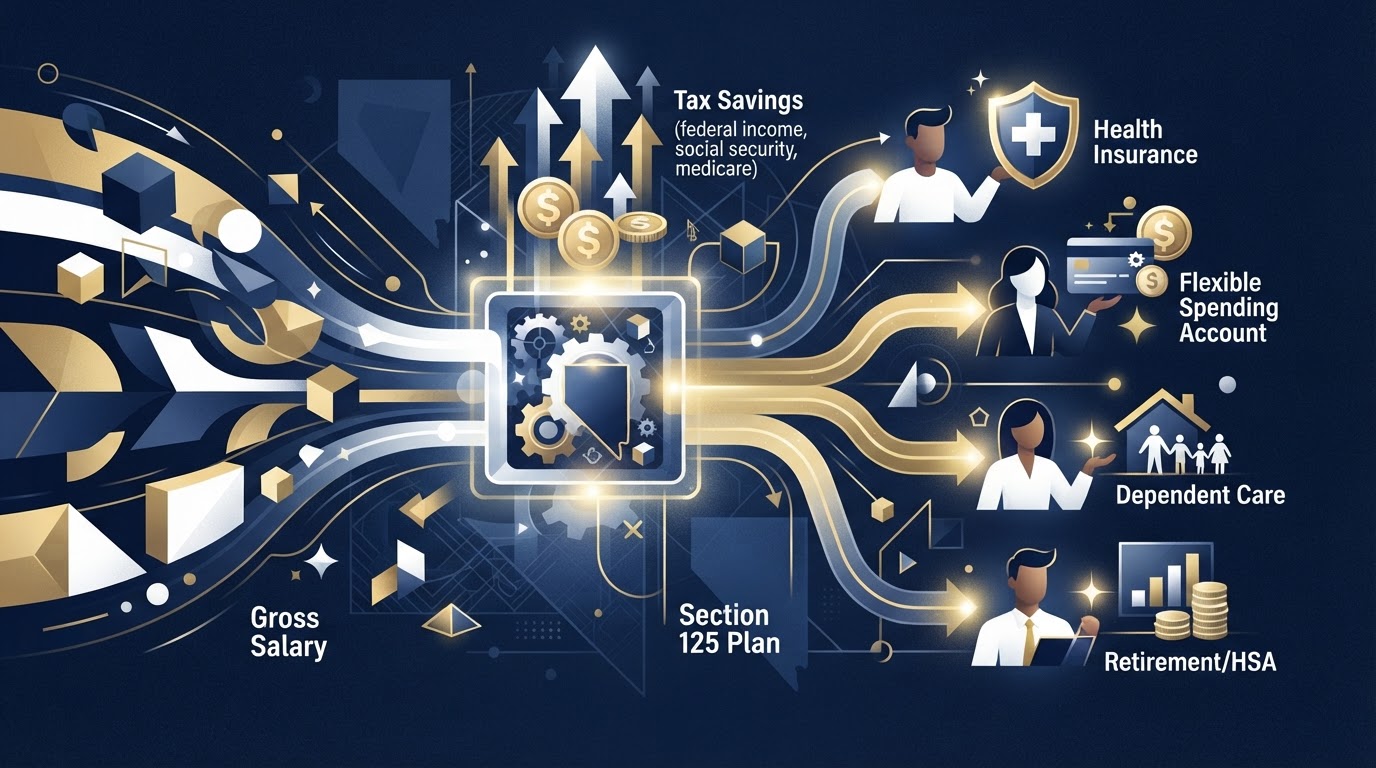
For Nevada employers searching for ways to control employee benefit costs without reducing coverage, a Section 125 Cafeteria Plan can allow employees to pay their share of certain qualified benefits with pre-tax dollars.
For Nevada employers searching for ways to control employee benefit costs without reducing coverage or simply shifting more expenses to employees, one of the most valuable strategies may already be available through the federal tax code.
It is called a Section 125 Cafeteria Plan.
For small and midsize businesses throughout Las Vegas, Henderson, Summerlin, North Las Vegas, Boulder City, and the rest of Nevada, a properly established Section 125 Cafeteria Plan can allow employees to pay their share of certain qualified benefits with pre-tax dollars rather than after-tax dollars.
That can potentially reduce employees' taxable compensation while also reducing certain payroll taxes for the employer.
At VisionPoint Insurance Solutions, we believe Nevada employers should look beyond the health insurance premium itself. The objective should be to evaluate the entire employee benefits structure—including insurance, employee contributions, tax strategies, funding arrangements, provider networks, and administration.
Section 125 can potentially work alongside fully insured group health insurance, Association Health Plans, level-funded health plans, Health Savings Accounts, Flexible Spending Accounts, and other qualified employee benefits.
Administration is important as well. VisionPoint Insurance Solutions can help employers evaluate established benefits administrators such as HealthEquity, WEX, Via Benefits, and other qualified providers. Depending on the arrangement, administrators may provide services involving Section 125 plans, HSAs, FSAs, HRAs, COBRA administration, reimbursements, participant accounts, billing, and other benefits-management responsibilities.
The objective is not to promote a particular administrator. It is to help Nevada employers build an employee benefits strategy that works efficiently for both the company and its employees.
Would you like to know whether a Section 125 Cafeteria Plan could improve your Nevada employee benefits strategy? Call VisionPoint Insurance Solutions at 888-322-2474, schedule a consultation through VisionPoint.Financial, or email info@visionpoint.financial.
What Is a Section 125 Cafeteria Plan?
A Section 125 Cafeteria Plan gets its name from Section 125 of the Internal Revenue Code.
The basic concept is relatively straightforward.
A cafeteria plan allows eligible employees to choose between taxable compensation, such as ordinary cash wages, and certain qualified benefits that may receive favorable federal tax treatment.
The term "cafeteria plan" reflects the concept that employees may have choices among qualifying benefits depending upon how the employer structures its program.
Importantly, Section 125 is not health insurance.
It is a tax-advantaged framework that can surround an employer's benefits program.
For example, a Las Vegas small business may already offer group health insurance and require employees to contribute toward their monthly premiums.
A properly established Section 125 Premium Only Plan may allow qualifying employee premium contributions to be deducted from payroll on a pre-tax basis.
The employer may not need to change the insurance carrier.
The employer may not need to change the health plan.
What changes is how qualifying employee contributions are treated for tax purposes.
How Do Pre-Tax Health Insurance Premiums Work?
Consider an employee earning $50,000 annually who contributes $300 per month toward employer-sponsored health insurance.
Over 12 months, the employee contributes:
$300 × 12 = $3,600
If those contributions are made with after-tax compensation, applicable taxes are generally calculated before the employee uses the remaining money for the insurance contribution.
Under a properly established Section 125 arrangement, qualifying employee contributions may instead be deducted before certain federal income and payroll taxes are calculated.
The employee still contributes $3,600 toward health insurance.
The difference is the tax treatment of those dollars.
For employers trying to make their benefits package more valuable without dramatically increasing company contributions, that distinction can be important.
How Can Employees Benefit From a Section 125 Plan?
The primary employee advantage is the ability to pay for certain qualified benefits with pre-tax compensation.
Depending upon the benefit and individual circumstances, this may reduce compensation subject to federal income tax and certain payroll taxes.
This creates an opportunity for employers facing rising Nevada group health insurance costs.
Suppose an employer cannot afford to substantially increase its contribution toward employee health insurance this year.
Rather than immediately reducing benefits or shifting the entire increase to employees, the company can examine whether its existing contribution structure is as tax-efficient as possible.
A Section 125 Cafeteria Plan may help employees receive greater value from compensation they are already earning.
How Can Nevada Employers Save Money With Section 125?
Employees are not necessarily the only ones who benefit.
When qualifying employee salary reductions are excluded from wages for certain federal payroll-tax purposes, the employer may reduce its corresponding payroll-tax expense.
Consider a Nevada business with 20 participating employees.
Suppose each employee contributes an average of $300 per month toward qualifying benefits.
Annual employee contributions would equal:
20 employees × $300 × 12 months = $72,000
If those qualifying contributions are excluded from wages subject to the employer's 7.65% Social Security and Medicare taxes, the illustrative potential employer FICA savings would be:
$72,000 × 7.65% = $5,508
This is an illustration, not a guaranteed savings calculation.
Actual savings depend upon employee compensation, applicable wage bases, participation, plan design, elections, and the employer's particular tax circumstances.
Nevertheless, it demonstrates an important principle:
A Nevada employer may potentially reduce certain employment-related costs without reducing employee benefits.
What Is a Section 125 Premium Only Plan?
One of the simplest applications of Section 125 is commonly called a Premium Only Plan, or POP.
A Premium Only Plan establishes a structure through which employees may pay qualifying insurance premiums using pre-tax payroll deductions.
Depending upon the benefits offered and applicable requirements, qualifying contributions may include certain employee payments toward:
- Group medical insurance
- Dental insurance
- Vision insurance
- Certain other qualified employer-sponsored benefits
For many Nevada small businesses, a Premium Only Plan can be an excellent starting point.
The employer already offers group health insurance.
Employees already contribute toward premiums.
The Section 125 plan creates the framework that may allow qualifying employee contributions to receive pre-tax treatment.
Section 125 Plans for Las Vegas and Nevada Small Businesses
Section 125 plans are not reserved for major corporations.
Small and midsize Nevada employers may also be able to benefit.
For businesses in Las Vegas and throughout Clark County, healthcare costs can represent one of the largest expenses after payroll. Finding another health insurance carrier is therefore only one way to address costs.
Employers should also examine how the benefits program itself is structured.
A comprehensive Nevada employee benefits review can examine:
- Employer premium contributions
- Employee premium contributions
- Section 125 opportunities
- Fully insured plans
- Level-funded health plans
- Association Health Plans
- PPO and HMO networks
- HSA-qualified plans
- Flexible Spending Accounts
- COBRA administration
- Benefits administration
This is why VisionPoint Insurance Solutions generally approaches employee benefits as an overall financial strategy rather than simply an annual insurance purchase.
Section 125 and Flexible Spending Accounts
A Section 125 Cafeteria Plan may also include a Health Flexible Spending Account, commonly called an FSA.
A Health FSA allows employees to elect a portion of compensation for eligible healthcare expenses on a pre-tax basis.
Depending upon applicable requirements, eligible expenses may include certain:
- Deductibles
- Copayments
- Coinsurance
- Prescription expenses
- Dental expenses
- Vision expenses
- Medical supplies
- Other qualified healthcare expenses
FSAs operate under specific federal requirements concerning elections, reimbursements, eligible expenses, annual limits, and unused funds.
Administration therefore matters.
Employers need systems for employee elections, claims submissions, reimbursements, account balances, and other administrative responsibilities.
Section 125 and Dependent Care Benefits
A cafeteria plan may also include qualifying dependent-care benefits.
A Dependent Care FSA can allow eligible employees to set aside pre-tax compensation for qualifying dependent-care expenses that enable the employee—and, when applicable, a spouse—to work or look for work.
Depending upon individual circumstances and federal requirements, eligible expenses may include qualifying:
- Daycare
- Preschool
- Before-school programs
- After-school programs
- Summer day camps
- Care for certain qualifying dependent adults
For employees raising children or caring for qualifying dependents, this can add meaningful value to an employee benefits package.
Section 125 and Health Savings Accounts
Health Savings Accounts, commonly known as HSAs, may also interact with Section 125 Cafeteria Plans.
When eligibility requirements are satisfied, HSA contributions made through a Section 125 salary-reduction arrangement can receive favorable federal tax treatment.
An eligible employee generally must participate in an HSA-qualified high-deductible health plan and satisfy other federal requirements.
HSAs can provide several potential advantages.
- Qualifying contributions may receive favorable tax treatment.
- Balances can generally accumulate from year to year.
- The account belongs to the individual.
- Funds may be used for qualified medical expenses.
- Employees can generally retain their HSA after changing employers.
However, benefits must be coordinated carefully. Participation in certain types of FSAs, for example, can affect an individual's eligibility to contribute to an HSA.
Section 125 With Fully Insured Health Insurance
Section 125 is not limited to a particular health insurance funding method.
Employees participating in traditional fully insured group health insurance may be able to make qualifying premium contributions through a Section 125 arrangement.
Under fully insured coverage, the insurance carrier generally assumes claims risk in exchange for the premium.
Section 125 addresses a different issue:
How are qualifying employee benefit contributions treated for tax purposes?
The two strategies can therefore work together.
Section 125 With Nevada Association Health Plans
Nevada employers may have access to Association Health Plans through qualifying chambers of commerce, professional organizations, or trade associations.
Depending upon the specific arrangement, qualifying employee contributions toward Association Health Plan coverage may potentially be handled through a Section 125 structure.
This can be especially relevant for Clark County employers evaluating Association Health Plans alongside traditional Nevada small business health insurance.
The Association Health Plan determines the underlying insurance arrangement.
Section 125 addresses the tax treatment of qualifying employee benefit elections and contributions.
Employers should evaluate both.
Section 125 With Level-Funded Health Plans
Level-funded health plans have become increasingly important for small and midsize employers.
These arrangements typically combine predictable monthly funding with stop-loss protection and certain characteristics associated with self-funded healthcare.
A Section 125 Cafeteria Plan may potentially operate alongside an eligible level-funded health plan.
Again, these strategies address different parts of the benefits equation.
Level funding addresses how healthcare costs and risk are financed.
Section 125 addresses the tax treatment of qualifying employee elections and contributions.
Instead of asking only:
"Which Nevada health insurance plan has the lowest premium?"
Employers should consider asking:
"Which combination of insurance, funding, employee contributions, tax strategy, provider networks, and administration creates the greatest overall value?"
If you would like VisionPoint Insurance Solutions to compare your existing group health insurance and Section 125 opportunities, call 888-322-2474, schedule a consultation through VisionPoint.Financial, or email info@visionpoint.financial.
Who Administers a Section 125 Plan?
Designing the strategy is only part of the process.
Someone has to administer it.
Depending upon the benefits offered, employers may need systems for:
- Eligibility
- Employee elections
- Payroll deductions
- Contributions
- Reimbursements
- Account balances
- Required notices
- COBRA administration
- Premium collection
- Reporting
- Recordkeeping
- Employee questions
Large employers may maintain dedicated benefits departments.
A Nevada small business may have one office manager or administrator handling payroll, HR, insurance, bookkeeping, and employee questions simultaneously.
Professional benefits administration can therefore be valuable.
Working With Third-Party Benefits Administrators
VisionPoint Insurance Solutions can help Nevada employers evaluate and coordinate with established benefits administration companies.
Depending upon the employer's requirements, these may include companies such as HealthEquity, WEX, Via Benefits, or other qualified administrators.
Administrative fees may apply depending upon the provider, services selected, number of employees or accounts, and contractual arrangement.
Available services may include:
- Section 125 Premium Only Plan administration
- HSA administration
- FSA administration
- HRA administration
- Dependent Care FSA administration
- Employee account management
- Contribution processing
- Claims and reimbursement administration
- Participant support
- Employer reporting
- Payroll integration
- COBRA administration
- Direct billing
- Other employee benefit administration
The purpose is not to select an administrator simply because it is well known.
The objective is to determine which administrative solution best fits the employer.
Section 125 and COBRA Administration
COBRA deserves particular attention because continuation coverage can involve substantial administrative responsibilities.
Employers subject to federal COBRA requirements may need to manage:
- Initial notices
- Qualifying events
- Election notices
- Eligibility tracking
- Election periods
- Premium billing
- Premium collection
- Effective dates
- Termination dates
- Participant communications
- Recordkeeping
Qualified third-party administrators can handle many of these responsibilities.
For a Nevada employer without a large HR department, outsourcing COBRA administration may reduce internal workload and provide access to systems specifically designed for continuation-coverage administration.
Why Benefits Administration Costs Should Be Evaluated Carefully
Professional benefits administration generally is not free.
Administrative fees may apply.
But employers should compare those fees against the actual cost of performing the same work internally.
That can include:
- Staff time
- Payroll expense
- Technology
- Employee support
- Recordkeeping
- Administrative complexity
- Compliance responsibilities
The correct comparison is therefore not necessarily:
Administrative fee versus zero cost.
Instead, employers should evaluate the administrative fee against the full internal cost and burden of managing the program themselves.
A Nevada Section 125 Savings Example
Consider a Nevada employer with 25 participating employees.
Suppose each employee contributes an average of $250 per month toward qualifying employer-sponsored health insurance.
Annual employee contributions would equal:
25 employees × $250 × 12 months = $75,000
If those qualifying contributions receive pre-tax treatment through a properly established Section 125 plan, employees may reduce compensation subject to certain federal taxes.
The employer may potentially reduce certain payroll taxes as well.
Using the 7.65% employer Social Security and Medicare rate as a simplified illustration:
$75,000 × 7.65% = $5,737.50
That represents approximately $5,737 in illustrative potential employer FICA savings.
Actual results depend upon employee wages, applicable wage bases, participation, plan structure, and tax circumstances.
This demonstrates why a Section 125 review should be part of the broader conversation about controlling Nevada group health insurance costs.
Nevada Modified Business Tax Considerations
Nevada employers should understand that federal Section 125 treatment and Nevada Modified Business Tax treatment are separate issues.
Nevada has specific rules governing the treatment of qualifying employer-paid health insurance or health-benefit expenses when calculating taxable wages for Modified Business Tax purposes.
An expense receiving favorable federal treatment under Section 125 does not automatically receive identical Nevada tax treatment.
Employers should evaluate federal and Nevada tax treatment separately and consult appropriate tax or accounting professionals regarding their individual circumstances.
Section 125 Plan Documents
A Section 125 arrangement should not simply consist of telling payroll to begin taking deductions before taxes.
Federal requirements call for a written plan.
Plan documentation should address matters such as:
- Eligibility
- Benefits offered
- Employee elections
- Plan year
- Contribution procedures
- Election changes
- Applicable benefit provisions
The plan document, payroll system, underlying insurance program, and benefits administration should work together.
Section 125 Nondiscrimination Requirements
Section 125 plans are subject to federal nondiscrimination requirements.
These rules are intended to prevent cafeteria plans from disproportionately favoring highly compensated employees or key employees.
Requirements vary depending upon the benefits and structure involved.
Employers should ensure their plan is properly designed and administered rather than assuming compliance merely because the business is small.
Common Section 125 Mistakes Nevada Employers Should Avoid
Taking Pre-Tax Deductions Without Proper Documentation
A written plan document is fundamental.
Assuming Every Benefit Qualifies
Not every employee benefit qualifies for favorable Section 125 treatment.
Ignoring Election Rules
Employees generally cannot change elections whenever they choose.
Poor Payroll Coordination
Payroll, employee elections, plan documents, and administration need to work together.
Ignoring COBRA Responsibilities
Employers subject to COBRA need appropriate procedures for qualifying events, notices, elections, billing, and continuation coverage.
Confusing Federal and Nevada Tax Rules
Federal Section 125 treatment does not automatically determine Nevada tax treatment.
Failing to Review the Program
Insurance carriers change. Employee contributions change. Businesses grow. Benefits change. The Section 125 plan should continue to reflect the employer's actual benefits program.
Why VisionPoint Reviews Section 125 During Health Insurance Renewals
VisionPoint Insurance Solutions generally recommends beginning a Nevada group health insurance renewal review approximately 90 days before the renewal date.
A comprehensive review should involve more than collecting insurance quotes.
Employers should consider:
- Current premiums
- Renewal increases
- Employer contributions
- Employee contributions
- Fully insured alternatives
- Association Health Plans
- Level-funded alternatives
- PPO and HMO networks
- HSA-qualified plans
- Section 125 opportunities
- FSAs
- HRAs when appropriate
- COBRA administration
- Benefits administration
- Provider networks
- Prescription benefits
- Employee out-of-pocket expenses
- Overall benefit costs
For many employers, the strongest solution is not one isolated insurance product.
It is a coordinated employee benefits strategy.
Frequently Asked Questions About Section 125 Plans in Nevada
Does a Small Business in Nevada Need a Section 125 Plan?
If employees are paying qualifying insurance premiums on a pre-tax basis, the employer should understand the Section 125 requirements and ensure the arrangement is properly established. Whether a particular business should establish a cafeteria plan depends upon its benefits structure.
How Much Can a Nevada Employer Save With a Section 125 Plan?
Potential savings depend on employee participation, qualifying pre-tax contributions, wages, applicable tax limits, and other factors. Employers may potentially reduce certain payroll taxes on qualifying salary reductions.
Can a Las Vegas Small Business Establish a Section 125 Plan?
Yes. Section 125 plans are not limited to large employers.
Is Section 125 Health Insurance?
No. Section 125 provides a tax-advantaged framework for certain qualified employee benefits. The underlying health insurance is separate.
Can Section 125 Work With Fully Insured Health Plans?
Potentially, yes.
Can Section 125 Work With a Nevada Association Health Plan?
Potentially, yes, depending upon the underlying benefits and arrangement.
Can Section 125 Work With Level-Funded Health Insurance?
Potentially, yes. Funding structure and Section 125 tax treatment address different components of the employee benefits strategy.
Can an Employer Offer an FSA Through Section 125?
Yes, a cafeteria plan may include a Health FSA subject to applicable requirements.
Can HSA Contributions Be Made Through Section 125?
Qualifying HSA contributions may be made through a cafeteria plan when applicable HSA eligibility requirements are satisfied.
Who Can Administer These Benefits?
Employers may handle certain responsibilities internally or use qualified third-party administrators. VisionPoint can help employers evaluate administrators based on services, technology, fees, integration capabilities, and the company's particular needs.
Can COBRA Administration Be Outsourced?
Yes. Qualified administrators can provide services involving notices, participant administration, premium billing and collection, eligibility processing, and reporting.
The Bottom Line
A Section 125 Cafeteria Plan can be one of the most useful—and frequently overlooked—components of a Nevada employee benefits strategy.
For employees, qualifying pre-tax contributions may reduce taxable compensation and make existing benefits more affordable.
For employers, qualifying salary reductions may reduce certain payroll-tax expenses.
But Section 125 should not be viewed in isolation.
A comprehensive benefits strategy may combine:
- Nevada group health insurance
- Section 125
- Fully insured plans
- Level-funded plans
- Association Health Plans
- PPO and HMO networks
- HSAs
- FSAs
- Dependent-care benefits
- HRAs when appropriate
- COBRA administration
- Professional benefits administration
At VisionPoint Insurance Solutions, our objective is to help Nevada employers understand how these pieces work together.
The question should not simply be:
"How can we find cheaper health insurance?"
A better question is:
"How much value can we create from every dollar we spend on employee benefits?"
For a business owner, that distinction matters.
Would you like VisionPoint Insurance Solutions to review your current Nevada group health insurance and determine whether a Section 125 Cafeteria Plan, professional benefits administration, or another strategy could improve your benefits program? Call 888-322-2474, schedule a consultation through VisionPoint.Financial, or email info@visionpoint.financial.
Important Information
Section 125 Cafeteria Plans, HSAs, FSAs, HRAs, COBRA, and related benefits involve federal tax, healthcare, and employee-benefit requirements. This article is provided for general educational purposes and is not intended as legal, accounting, or tax advice. Employers should consult appropriate tax, legal, payroll, or benefits professionals regarding their individual circumstances.
Related Articles
For a more complete understanding of Nevada employee benefits, employers should also read:
- Nevada Small Business Health Insurance: How Employers Can Lower Costs and Improve Benefits
- Fully Insured vs. Level-Funded Health Plans: Which Is Right for Nevada Employers?
- Association Health Plans in Clark County and Nevada: A Guide for Small Business Owners
- PPO vs. HMO: Which Group Health Insurance Plan Is Right for Your Nevada Business?
- ICHRA vs. QSEHRA in Nevada: A 2026 Guide for Las Vegas Small Businesses
Need Personalized Guidance?
Our advisors can help you apply these concepts to your specific situation.